
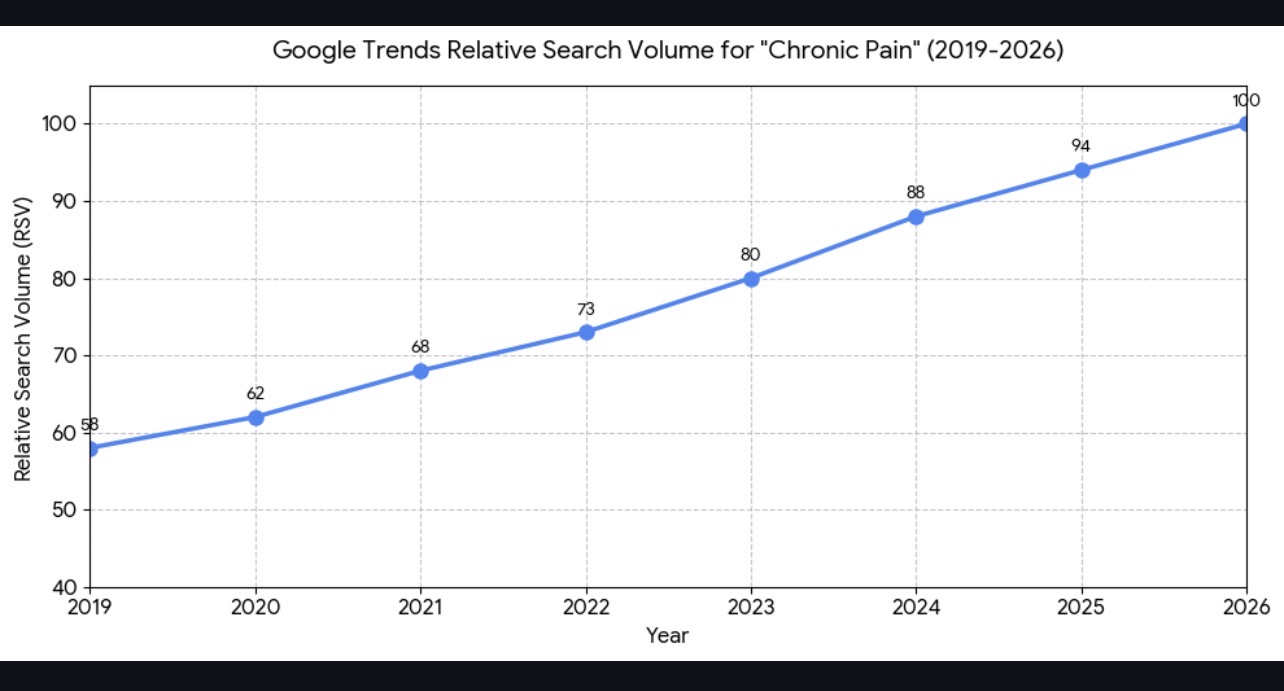
Chronic Pain Search Trends: What Google Data Reveals in 2026
Pain Management, Wellness Trends, Google Trends, Longevity Strategies, Medspa Growth, Healthcare Demand
What Rising Google Searches Reveal About the Future of Pain Management and Wellness
Growing search demand on Google Trends is more than a digital curiosity—it is a real-time barometer of how patients think, worry, and shop for care. For pain management practices, longevity clinics, medspas, and wellness centers, understanding these signals is fast becoming a strategic imperative, not a “nice to have.”
Turning Search Data Into Clinical Strategy
How rising online interest is reshaping pain and wellness demand
Google Trends: A Real-Time Pulse on Healthcare Demand
Over the past several years, Google Trends has consistently shown rising interest in pain, self-treatment, and wellness-related topics. Studies tracking searches for “pain” across Europe, for example, found clear daily and weekly patterns, with queries peaking in the early hours of the morning and on weekends when patients are away from clinicians and seeking answers on their own. At the same time, global interest in common analgesics such as acetaminophen and ibuprofen has steadily climbed, reflecting a sustained focus on pain relief and self-management.
Parallel research on wellness trends points to surging curiosity around longevity, neurowellness, stress regulation, and personalized interventions. Consumers are acting more like “CEOs” of their own health, using search to compare options, evaluate evidence, and locate providers who align with their values—whether that means science-backed longevity strategies, non-opioid pain solutions, or integrated medspa and wellness offerings.
💡 Pro Tip for Stakeholders: Treat Google Trends as an ongoing listening tool. Track rising queries in your region and align service design, patient education, and marketing to the language patients actually use.
What Rising Search Demand Means for Pain Management
For pain specialists, the increase in search volume around “pain,” specific body regions, and non-opioid analgesics signals both opportunity and responsibility. Recent workers’ compensation data in the United States show a shift away from opioids toward topical agents, gels, and multimodal approaches. Google Trends mirrors this transition, with more patients searching for “topical pain relief,” “alternatives to opioids,” and “chronic pain management” options.
Clinical positioning: Highlight non-opioid, multimodal Pain Management protocols—nerve blocks, interventional procedures, physical therapy integration, and behavioral support—to meet rising expectations for safer, sustainable care.
Patient education: Develop content that directly answers high-volume queries (“night-time back pain,” “nerve pain vs muscle pain,” “when to see a specialist”) to guide searchers toward evidence-based care rather than unvetted remedies.
Access and timing: Early-morning search spikes suggest unmet needs outside office hours. Consider telehealth triage, nurse lines, or structured self-management resources patients can access when symptoms flare.
In short, increasing digital demand underscores that chronic pain is not only prevalent but under-supported. Practices that respond with transparent, accessible information and flexible care models will be best positioned as Healthcare Demand continues to climb.
Longevity Strategies: From Buzzword to Expectation
On the wellness side, search interest in “longevity,” “healthspan,” and “biohacking” has moved from fringe to mainstream. Industry reports describe 2026 as the year longevity becomes both more scientific and more inclusive, with particular focus on women’s healthspan—ovarian aging, menopause, and cardiovascular risk. Patients are no longer satisfied with generic “anti-aging”; they want personalized Longevity Strategies supported by diagnostics and outcomes data.
For clinicians and operators, this shift means reframing longevity as a continuum that connects pain, metabolic health, neurowellness, sleep, and emotional regulation. Search behavior shows that consumers are actively looking for:
Comprehensive testing—hormones, micronutrients, inflammation markers, and advanced imaging.
Personalized nutrition, including functional beverages and targeted supplementation.
Programs that integrate movement, nervous system regulation, and sleep optimization.
Providers who can connect the dots between pain prevention, mobility, and long-term function will stand out in a crowded longevity market. Positioning pain control as foundational to healthy aging aligns directly with how patients are searching and thinking.
Medspa Growth: Search Demand Meets Explosive Market Expansion
The medspa sector offers a striking example of how digital curiosity converts into real-world expansion. By 2026, U.S. medspas are estimated to generate roughly $18–20 billion in revenue, growing at about 14% annually, with thousands of mostly single-location clinics competing for attention. Global estimates show similar double-digit growth, with the market projected to reach tens of billions of dollars over the next decade.
Rising search volume for injectables, laser resurfacing, body contouring, and “medspa near me” reflects a consumer base that is both highly motivated and highly discerning. For operators, this has several implications for Medspa Growth:
Differentiation through wellness: Integrating IV therapy, hormone optimization, neurowellness, and recovery services can transform a cosmetic-focused medspa into a broader wellness destination.
Evidence and safety: As patients search for side effects, downtime, and long-term results, transparent education and medical oversight become competitive advantages.
Membership and retention: Search may bring patients in the door, but structured memberships, follow-up protocols, and integrated wellness plans keep them engaged.
Wellness Centers: Aligning Services With Emerging Wellness Trends
For multidisciplinary wellness centers, the convergence of Wellness Trends visible in Google searches—longevity, nervous system health, community-based experiences, and sustainable practices—creates a roadmap for service design. Searches are shifting from isolated concerns (“stress,” “insomnia”) toward integrated solutions (“nervous system reset,” “burnout recovery retreat,” “community sauna”).
To meet evolving Healthcare Demand, leading centers are:
Combining clinical services—such as primary care or functional medicine—with group-based rituals, breathwork, and movement.
Offering employer-focused programs for burnout, mental health, and preventive care, reflecting strong corporate investment in well-being.
Emphasizing environmental responsibility—plastic reduction, clean product curation, and nature-connected spaces—as part of whole-person health.
Turning Search Signals Into Strategy
For pain clinics, longevity programs, medspas, and wellness centers, the message from Google Trends is clear: demand is rising, but it is also evolving. Patients are looking for integrated, science-backed, and human-centered solutions—and they are using search to decide whom to trust. Organizations that systematically monitor search patterns, translate them into services and education, and communicate clearly in patient language will be best positioned to thrive in the next era of health and wellness.